


Every once in a while, I’m reminded that no one can read my mind. I often assume that the people on my creative team can see the project as clearly as I do, so I’m always a little surprised when someone suggests an idea that seems completely unrelated to what I imagined. That happened recently during a team meeting, and it made me realize that I need to be more generous in sharing the vision before asking others to help shape it.
So here I am, sharing with you—and perhaps with the world—what I have in mind for an upcoming experience on an island in Maine. At its heart, it’s about how ordinary objects carry memories and stories, and how those stories can connect us to people we have never met.
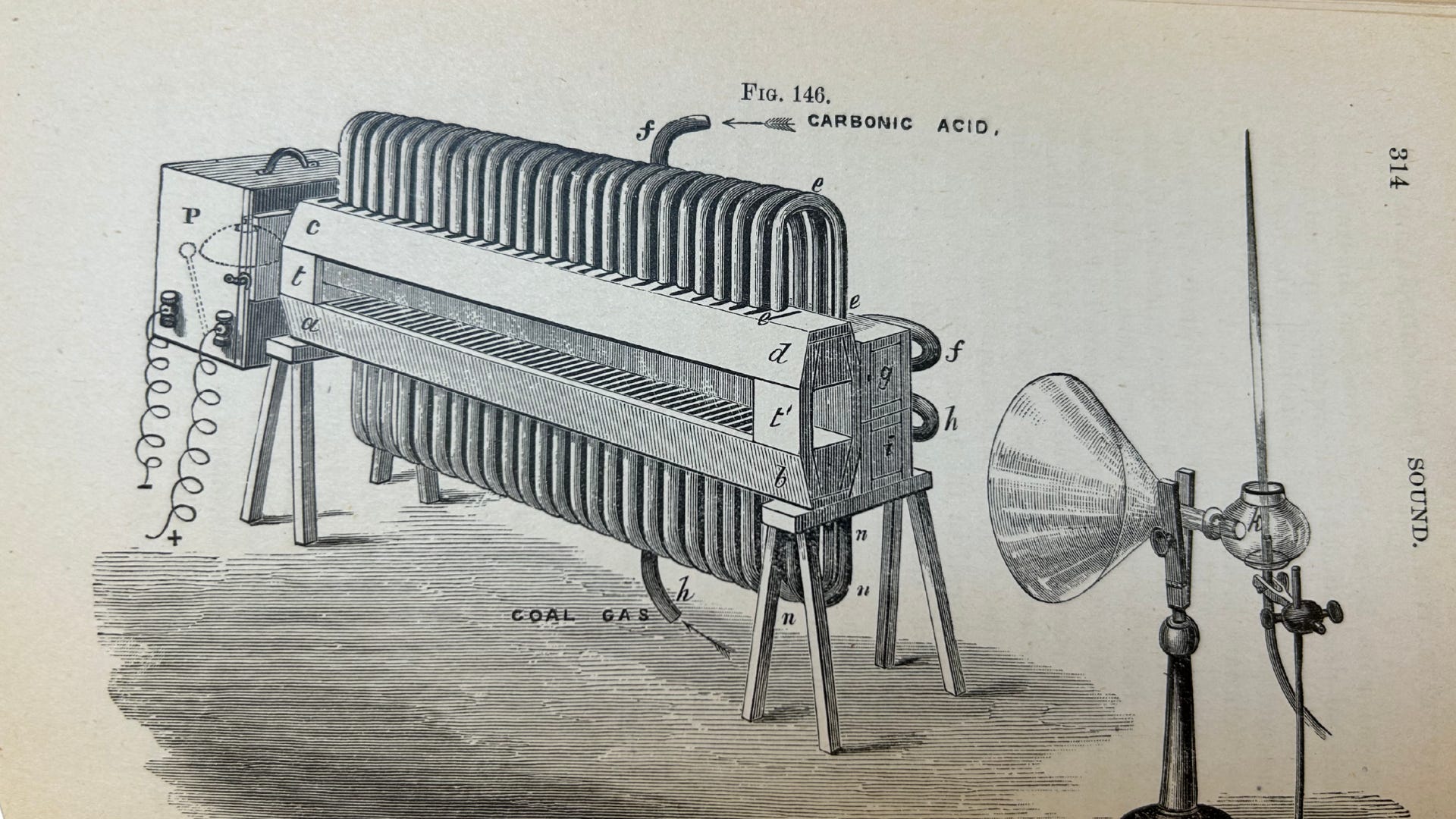
I’m curious about how ordinary objects become evidence of extraordinary humans, humans who create the things that keep our world moving, thriving, and exploring. To see them, I look not at the people themselves but at what they made: books, horns, trains, roads, and food. These everyday objects and systems form the infrastructure of our lives, quietly revealing the imagination and labor of those who came before us.
A few years ago, I wrote about the humans in our food system—unsung heroes with deep, unexpected stories to tell. Now my attention has shifted to what I call industrial sounds: the sounds that linger in our analog world yet are steadily disappearing. The clatter of a typewriter, the blast of a steam whistle, the clicking rhythm of an adding machine. These sounds are more than mechanical noise. They are portals to the people who invented tools to solve problems: a horn to warn others, a typewriter to communicate, a foghorn to mark a dangerous coast.
Take a minute now, listen to your surroundings. What do you hear? The hum of your refrigerator? The distant leaf blower, a car passing, a jack hammer in the street nearby?
Why do these particular sounds matter to me?
I’ve long been fascinated by industrial sounds because of my interest in nineteenth-century science, industrialization, and the mechanical devices humans created to help one another flourish. Every one of these sounds carries within it the story of curiosity, experimentation, and invention. As the sounds disappear, so too do the stories of the people who imagined them—the inventors, mechanics, engineers, and entrepreneurs whose work quietly shaped everyday life.
Industrial sounds are difficult to notice precisely because they exist in the background. We train ourselves to tune them out. But what if we tuned them in? What might we discover?
Some have already vanished, like the acoustic handshake between early computers. Others are on the verge of extinction, such as the raspy slide of a credit card imprinter. Each year our soundscape grows quieter in ways we rarely recognize.
But what comes next? Which sounds will soon disappear? And why should that matter?
Every one of these sounds exists because someone once confronted a problem and imagined a solution. They designed it, built it, and gave it a voice. When those sounds disappear, something else disappears with them: our sensory connection to the people who made our world. These artifacts emerged from a time before AI, when turning raw materials into useful objects depended on the knowledge, judgment, and skill of human hands.
Of course, the loss of these sounds also represents progress. Digital technologies often accomplish the same tasks more efficiently and with fewer materials. Yet what we leave behind still matters. These disappearing sounds remind us where we came from and help us understand what it means to be human as we enter an AI future.
In a world becoming quieter, smoother, and increasingly frictionless, will we also become less aware of our own presence? If the sounds of human making disappear, do we lose something essential about how we recognize our work, our ingenuity, and our purpose?
I don’t yet have answers to those questions. But I believe they are worth listening for.
Now you know.

Read More Newsletters on the Lunar Society:


Read the Coop-to-Museum Series:


Catch up on some of my favorite and most-read newsletters:


Read my books: Humans In Our Food / Food Routes / The New Wizard War / Meat, Commerce, and The City
Watch my films: Shelf Life / The Arc of Oblivion / The Long Coast: Stream on Amazon Prime or Apple TV
This is such a lovely nudge to be present and also brings to mind the work of James Deetz, In Small Things Forgotten: An Archaeology of Early American Life. (During college, I had a chance to work with Deetz on an excavation in Virginia. I remember him showing up to the site early morning with a bag of pork rinds in one hand and a Schlitz beer in the other. This is going to be fun!) The symbolism and utility of the material culture he so brilliantly pointed the imagination to were things that someone, at some time in the past, had lovingly crafted. Inanimate objects that spoke to us in their own way, across time, once we showed up to look and listen.