


Can happiness be designed?
That question stayed with me long after I returned from a recent trip to Sweden—not because Sweden consistently ranks among the world’s happiest countries, but because one small gift changed the way I experienced an entire week there. It made me wonder whether happiness is less about where we are than about how we pay attention.
This summer, a group of close friends and I spent a week kayaking through Sweden’s St. Anna and Gryt archipelago, where thousands of granite islands gather along Sweden’s eastern coastline. The islands are quiet places—pine forests clinging to weathered rock, tiny farms tucked between coves, and long stretches of open water in the Baltic Sea where big white swans seem to appear without warning, alone or in pairs, as if they have always belonged to the silence.
Just before we launched our kayaks, a friend handed me a small dusty-rose soapbox. Inside the lid was a mirror. The box held a handful of curious objects: a few tiny magnets, a blank refrigerator magnet, a tube of superglue, a bag of googly eyes, a plastic magnifying glass, and a red silk thread bracelet. Alongside it was a notebook and a small zippered pouch for collecting found objects.
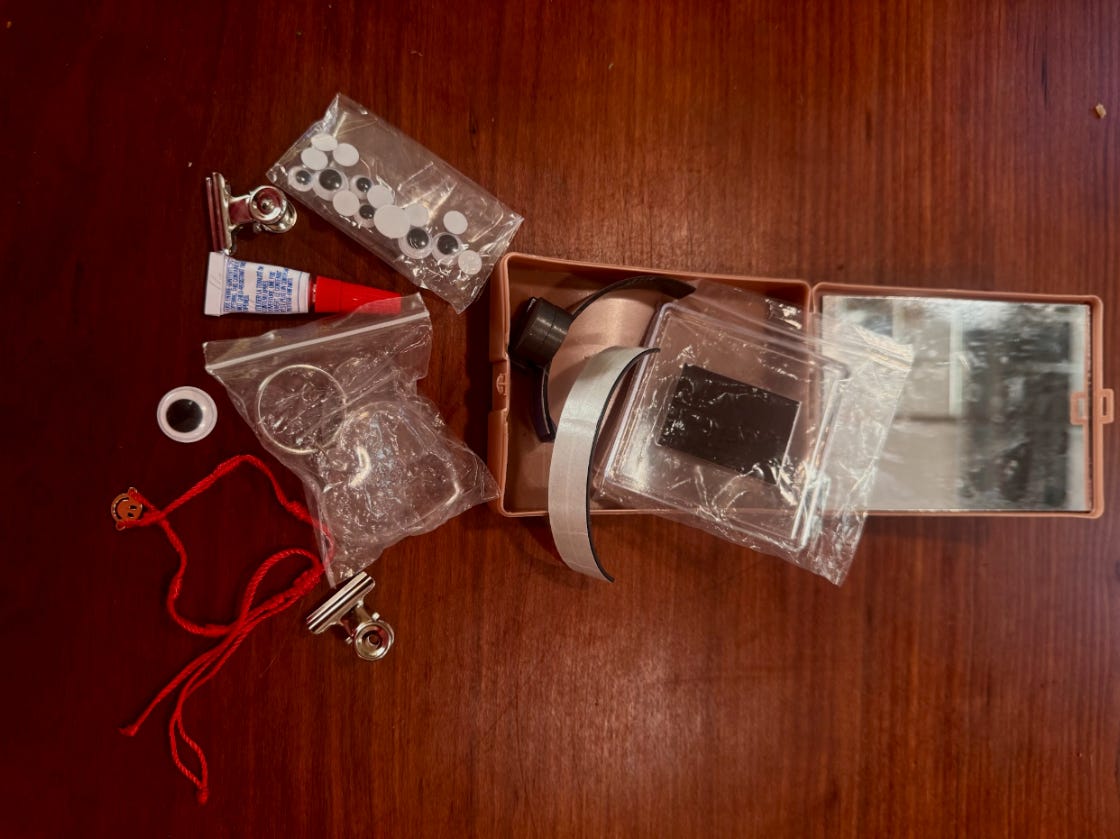
There were no instructions. No scavenger hunt. No list of assignments. No promise of what I should discover. Just an invitation to see what might happen.
The soapbox also contained, I realized later, a beautifully designed experience.
Almost immediately, the contents of the box began changing the way I moved through the landscape. I started collecting moss, feathers, bark, wildflowers, and bits of stone in the little pouch. I tied the red bracelet around my wrist and forgot about it until I caught sight of it throughout the day, a quiet reminder to notice where I was. I glued googly eyes onto my water shoes simply because it made me laugh. I filled the notebook with observations that I might otherwise have overlooked.

Nothing about the islands had changed. I had. The gift nudged me out of my familiar habits of travel. Instead of simply passing through a beautiful place, passively gliding along in my kayak on the surface of the Baltic Sea, I was more aware. Ordinary objects became artifacts. Small discoveries deepened my understanding the place. They put me in the present moment, drew me in. The landscape became something I entered rather than merely admired.
This, it seems to me, is what the best experience designers understand. They don’t manufacture happiness. They create conditions that make curiosity, playfulness, and attention more likely. They interrupt our routines just enough that we begin seeing differently.
Perhaps that is one reason happiness can feel so elusive. We often search for it in destinations, achievements, or possessions, while overlooking the quality of our own experience. A spectacular place experienced superficially remains just another photograph. A simple moment experienced deeply can become unforgettable.
As I was making my way home, I spent one night in a hotel in Stockholm. Riding the elevator to my room, I stepped in beside a man and woman whose smiles seemed almost impossibly radiant. Both wore conference badges.
The conference was called Eternal Happiness.
I smiled to myself.
Only a few days earlier I might have wondered what those experts knew that the rest of us didn’t. But after a week with a tiny soapbox full of seemingly random objects, I suspected the answer might be much simpler. Happiness isn’t only something we find or promote.
Sometimes it’s something that can be gently designed—through experiences that invite us to pay closer attention to the world, and in doing so, to ourselves. So yes, at least a nudge, an invitation to be more present can lead to what we might define as happiness. Perhaps the Swede’s are world class happiness designers. Or maybe I need more magnets and invitations to be happy.

Read More Newsletters on the Lunar Society:


Read the Coop-to-Museum Series:


Catch up on some of my favorite and most-read newsletters:


Read my books: Humans In Our Food / Food Routes / The New Wizard War / Meat, Commerce, and The City
Watch my films: Shelf Life / The Arc of Oblivion / The Long Coast: Stream on Amazon Prime or Apple TV
Agree with you that surprising stories can emerge once given a nudge through an unexpected object.
Happiness also has something to do with expectations. Too high? Too low? How do we know our expectations are close to just right? After an experience I like to go back in time and reset my expectations to just right.