


In the early days of my PhD research, I would sit for hours deep in the archives of the British Museum, carefully turning the worn and brittle pages of books and journals written during the nineteenth century. Librarians would place these books on a foam cradle, supporting their spines while my hands slowly lifted up one page at a time, gingerly turning the pages as I took notes. This experience, holding an original, old document in my hands, feeling its texture and weight, observing ink blots and stains, smelling the musky odor that rose from the fragile paper — inspired me to become a historian.
Sitting with an old document or object makes time slow or even stop as you realize that the thing in your hands belonged to people you will never know. It’s not a scan or a replica. It’s not an imagined copy; it’s the original thing with all its accumulated layers of meaning. We so rarely encounter the original thing anymore; we only see its digital shadow.
As you may know, I’m obsessed with archives and museums. I’ve been working on a portable personal museum, and the process has led me to think about curation, collections, and the strange emotional weight of objects. Just as I was beginning this article, I read a Substack written by a friend of mine in Austin. She’s also thinking about collections and invisible museums. It felt as though we had independently wandered into the same invisible museum.
Addie Broyles, writes beautifully about food, grief, and a lot more. You can enjoy her work here, where you can read about her experiences with invisible museum archives. We are both curious about the role of a curator and how museums seem to be sharing more of what they collect. Curators seem to be the gatekeepers of everyday objects. They decide what we see, when, and where.
What was the curator thinking when it came to selecting a receipt book from a meat salesman in Smithfield Market in 1853? Did the curator save all of those receipt books, or did the curator decide to save only a few? Why? What is kept for later generations, and what is discarded, never to be seen? What was the curator thinking?
Curators don’t just exist in museums. We also curate what the world sees and knows about ourselves. I remember when I met a futurist here in Austin who told me he had discovered an archive of ancient cookbooks. He proudly told me that he had scanned them into a digital archive — and then destroyed the physical books. He was delighted, and I was crushed as I imagined all the books with their material histories, the marginalia, imprints, stains, and other sensorial information. It is miraculous and wise to digitize everything, and at the same time, portends a slow evaporation of the physical world humans once made with their hands.
And yet, even as we digitize archives, we still continue to accumulate countless objects that weigh down the shelves of storage facilities, both our personal storage spaces and those of institutions such as museums. We can’t resist collecting evidence of ourselves.
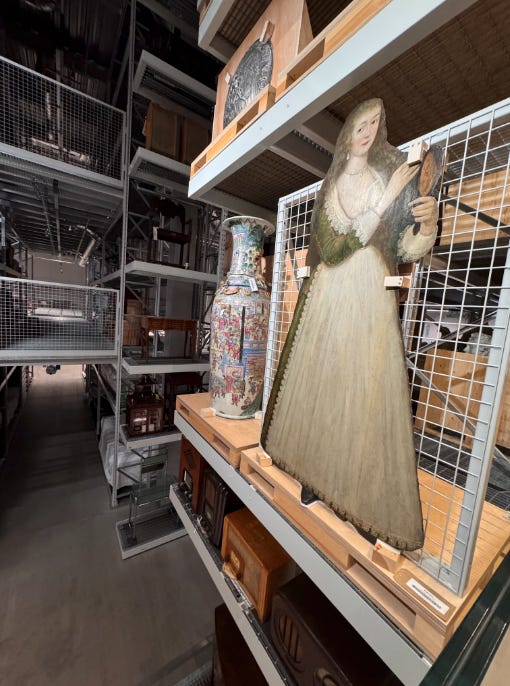
While in London in May for the World Experience Design Summit, I stopped by the Victoria and Albert East Storehouse. Opened about a year ago, the building occupies the Queen Elizabeth Olympic Park, The Storehouse is immense. Four floors contain over 600,000 objects, including an eclectic assortment of material objects from fashion, photography, theater, architecture, ceramics, sculpture, furniture, and decorative arts, oh, and 350,000 books. They are arranged in an order that feels random. A painting sits next to a lamp; a vase sits next to a dress. There are no labels or tags, so a visitor can make up their own story or imagine why the objects are juxtaposed. The storehouse contains some surprising objects, such as an office designed by Frank Lloyd Wright. The unique opportunity to see the vast number of objects on shelves without explanations and in random order takes us behind the scenes of a museum.
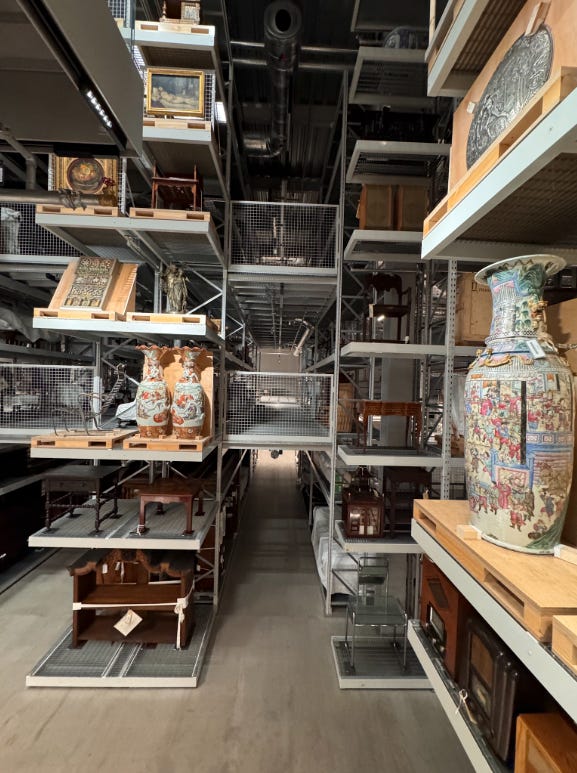
This trend towards museum transparency isn’t new, but it’s growing. Addie points out a museum that invites its community into its uncharted archives to determine what should be displayed and the stories behind them. But Addie also wonders if transparency, making available all of a museum’s collection, is actually a good thing. Can museums overshare? Constraints create mystery. Mystery creates longing. And longing gives objects their aura and value. To see everything may leave us feeling like we see nothing. Abundance flattens meaning.
Perhaps this is why curation matters so deeply. By selecting one object and placing it before us, the curator creates the conditions for attention. The object becomes illuminated, not just by light, but by focus. Addie suggests that we can’t carry every memory of everything. We can carry the few that are meaningful and close to us.
Do you think we should patiently await the curator who serves us bite-sized, memory-sized helpings of our material so we have time to satisfy our curiosity? Or should we be free to wander through the entirety of our collective material universe, choosing for ourselves what matters and what belongs in the stories we tell? You decide.

Read More Newsletters on the Lunar Society:


Read the Coop-to-Museum Series:


Catch up on some of my favorite and most-read newsletters:


Read my books: Humans In Our Food / Food Routes / The New Wizard War / Meat, Commerce, and The City
Watch my films: Shelf Life / The Arc of Oblivion / The Long Coast: Stream on Amazon Prime or Apple TV
This is fascinating! Thanks for reading and for sending this along. Gets me thinking about the relationship between exhibition design and experiences. Will follow your lead and dig deeper.
Love this—a renewed appreciation for the tactile and tangible really does feel like it’s in the air.
There's room for both: the curated exhibit to focus, and the open warehouse to wander. I love having the option. Serendipity wins either way--the curated exhibit has depth on a subject I may not have thought to explore yet. And the open warehouse lets me stumble (hopefully, not literally) on interesting objects to ponder.
This piece unearthed a few connective thoughts:
The Museum of Jurassic Technology in LA plays with the idea of personal collections as the foundation of public wonder—and of museums as we know them.
Maria Popova also recently emphasized the importance of physically going into archives for research, rather than relying on online sources alone—not everything has been digitized. https://youtu.be/yb9Tz-RQFN4?si=3k95lBsXl3Sd2hGm
And, on the subject of how ideas are physically presented through invisible design, one of my favorite recent Substack reads is this piece on exhibition anatomy: https://theobjectlabels.substack.com/p/the-anatomy-of-an-exhibition